
Amendment 3: what property-tax relief could mean for Pasco residents
Larger homestead exemptions could lower eligible homeowners’ taxes while leaving Pasco with major decisions about public services.

PASCO COUNTY, Fla. — Property-tax relief for homeowners could come with difficult choices for Pasco County’s libraries, parks, road projects and emergency services if voters approve Florida’s Amendment 3 in November.
The proposal would expand the homestead exemption for eligible homeowners while reducing the property-tax revenue available to local governments. Pasco’s FY2026-based projections put the first-year General Fund loss at $96.1 million, with separate reductions of $27.1 million for the Fire & Rescue taxing unit and $4.9 million for road rehabilitation. Together, those three funding streams would collect $128.1 million less in the first-year scenario. [August 11 budget discussion]
For residents, the central question is how much a lower tax bill would save—and how the county would adjust the services that bill helps support. The projections show the size of that challenge. They are not an adopted list of service cuts.
What would change on your tax bill?
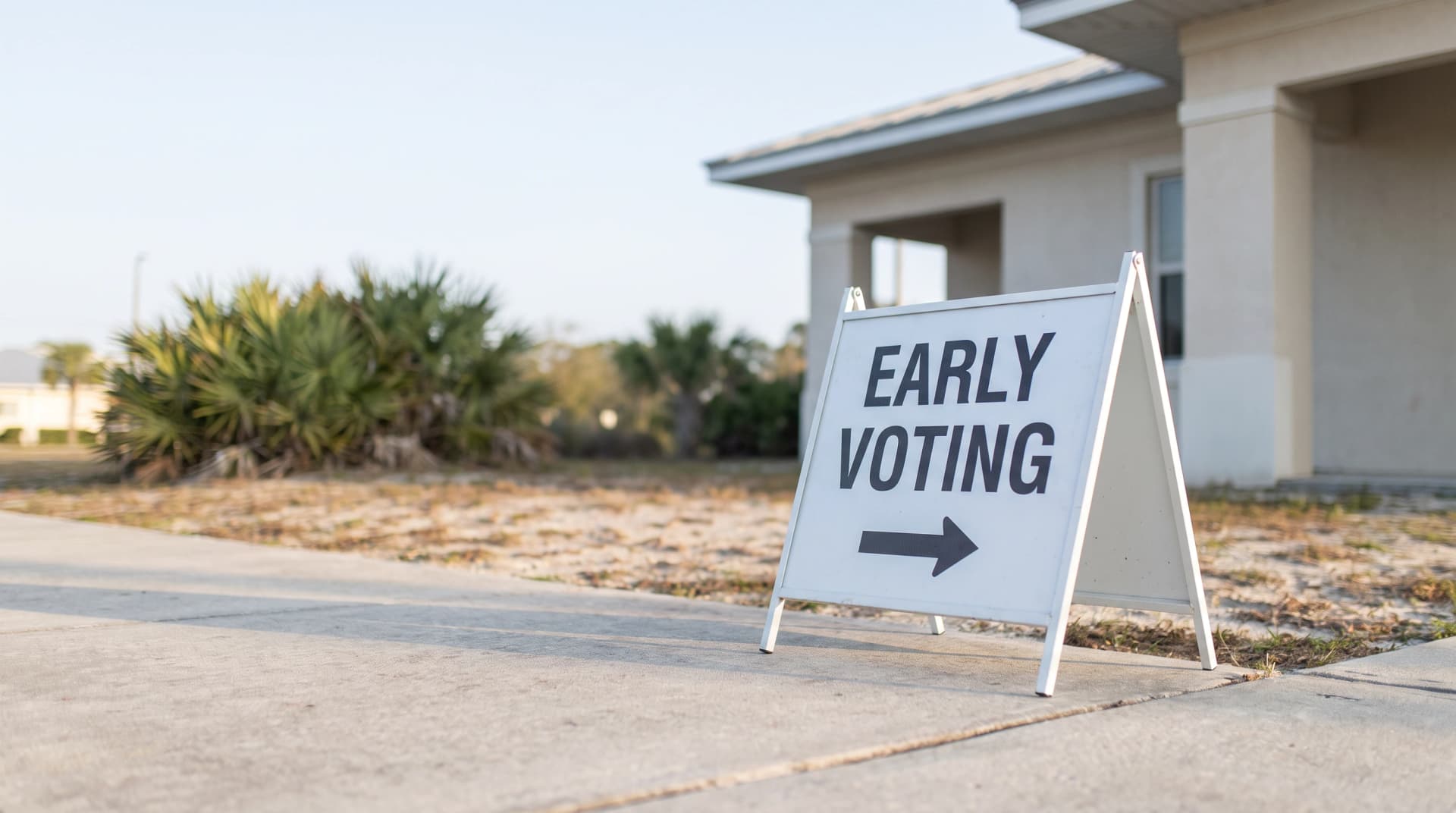
Amendment 3 will appear on the Nov. 3, 2026, ballot and requires 60% voter approval. It would take effect in 2027; it would not change the property-tax bill arriving in November 2026. [Tax Collector explainer]
According to the official ballot summary, the non-school homestead exemption would rise to $150,000 in 2027 and $250,000 in 2028, followed by inflation adjustments. New Florida residents who were not residents on Dec. 31, 2026, generally would receive the existing exemption until their fifth year of exemption. The annual assessment-growth cap for non-homestead property would drop from 10% to 5%.
School taxes would remain, as would applicable non-ad valorem assessments, including CDD charges. The proposal also establishes a process for further homestead exemptions; it does not automatically eliminate the entire tax bill. [What remains on the bill]
How much a household saves depends on its taxable value, exemption eligibility and applicable tax rates. For example, each additional $10,000 of exempt value saves $10 for every mill of applicable tax. At an illustrative eight mills, that increment saves $80. That is a calculation example, not a Pasco rate or a forecast for an individual home.
Why the General Fund faces a substantial challenge
The FY2026 expense breakdown reviewed for this analysis totals $567.20 million, excluding reserves in the accompanying budget scenario. Of that amount, $473.94 million is classified as mandated spending and $93.26 million as non-mandated spending.

A $96.1 million revenue loss would leave $471.10 million against that spending baseline, assuming no replacement revenue or other changes. That is less than the $473.94 million classified as mandated.
Even removing the entire $93.26 million non-mandated category would leave a $2.84 million gap. The $2.84 million is therefore the remaining gap after a sweeping reduction—not the amendment’s total impact on the General Fund.

The reduction amounts to 16.9% of this overall spending baseline. Percentages calculated against property-tax revenue alone use a smaller denominator and should not be confused with a percentage of the entire General Fund.
Libraries, parks and roads are part of the equation
“Non-mandated” is a budget classification, not a measure of how much residents value a service. It includes $25.36 million for Parks, Recreation & Natural Resources, $21.30 million for libraries and $18.93 million for engineering-services road capital. Together, those entries account for $65.60 million—70.3% of the non-mandated category.

Budget choices could affect recreation programs, library access, maintenance or the timing of construction. The available projections do not identify specific closures, reduced hours or canceled projects. Those would require separate decisions.
Nor does the amendment automatically prohibit every service classified as non-mandated. Its substantive text allows locally approved expenditures unless prohibited by general law. But permission to fund a service does not ensure the money will be available. Pasco’s official FAQ says the amendment does not guarantee funding levels for law enforcement, fire protection, EMS or other services.
What the fire and road projections mean
Pasco’s Fire & Rescue and Road Rehab Municipal Service Taxing Units, or MSTUs, are separate funding sources for designated services in defined areas. Their projections should not be read as the total budgets for every fire or transportation service countywide.

| Funding stream | Year 1 revenue loss | Year 2 revenue loss* |
|---|---|---|
| General Fund | $96.10 million | $156.30 million |
| Fire & Rescue MSTU | $27.10 million / 22.8% | $44.20 million / 37.1% |
| Road Rehab MSTU | $4.90 million / 22.7% | $8.10 million / 37.5% |
| Total across these three streams | $128.10 million | $208.60 million |
*Year 2 is the annual loss relative to the original baseline, not an additional amount subtracted from Year 1. Figures are modeled, not adopted spending reductions.
The first-year fire reduction would leave $91.95 million in that revenue stream; road rehabilitation would retain $16.71 million. Both losses round to approximately 23%. That does not mean emergency response would become 23% slower or that 23% of roads would go unrepaired. Revenue projections alone cannot establish those service outcomes.
The second-year annual loss across the three streams would be $80.5 million greater than the first-year loss. In the General Fund alone, holding the same spending baseline constant would leave a $63.04 million gap even after removing the entire non-mandated category.
Could other funding make up the difference?
County leaders could examine spending reductions, legally available fees, tax rates on the remaining taxable base, state assistance or a combination of approaches. Each option would affect residents differently, and none is automatic.
State funding of existing local obligations could reduce the pressure. The FY2026 expense breakdown includes $10.52 million for Medicaid. As an illustration, a full state takeover of that cost would offset about 10.9% of the first-year General Fund loss, leaving $85.58 million to address. That is a hypothetical option, not an enacted funding commitment.
Homeowners’ gross savings also would not necessarily equal their eventual net savings if other charges changed. Renters would not directly receive an owner-occupied homestead exemption, and any effect on rent would depend on landlords’ costs and decisions. Businesses and other non-homestead property owners would be affected differently, including through the lower assessment-growth cap.
Amendment 1 addresses a different issue
Voters also will consider Amendment 1, concerning Florida’s Budget Stabilization Fund. It would raise the reserve cap from 10% to 25% of general-revenue collections and require annual transfers of up to $750 million, subject to exceptions. It would not itself create a new tax or increase a tax rate.
The two measures concern different levels of government: Amendment 1 addresses state reserves, while Amendment 3 changes local property-tax revenue. Neither measure, on its own, promises Pasco a dollar-for-dollar replacement for lost revenue.
What Pasco residents should watch next
The county’s education materials use the adopted FY2026 budget to illustrate possible impacts, particularly for unincorporated Pasco. Actual future budgets will also reflect property values, growth, inflation, tax rates and any legislative or local response.
For Wesley Chapel, Land O’ Lakes and other unincorporated communities, county spending decisions are central to many everyday services. Residents of Dade City, San Antonio and Zephyrhills should also examine their city budgets and the taxing authorities listed on their individual bills. A countywide dollar estimate does not mean every neighborhood or household faces the same result.
The most useful next step is a specific set of budget options: which services would change, which revenues would replace lost taxes, and what each option would cost households. The current figures establish a substantial funding challenge. The choices made in response will determine how that challenge is felt in daily life.




What do you think?
Share your perspective with your neighbors.
Free to join. Your draft stays here while you sign in.
Be the first to share your thoughts.